


Article:
Beyond the headline tariff: designing energy offers that work in the real world

By Kirstin Crothers
For energy retailers, the challenge is no longer simply creating innovative products. It is understanding what customers do with them once they enter the home.
The promise—and complexity—of free power
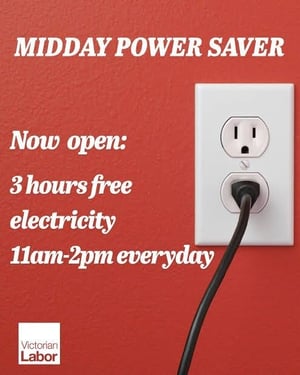 Victoria’s new Midday Power Saver offer provides a timely test. From October 2026, eligible households can access free electricity between 11am and 2pm each day, with the government estimating annual savings of between $149 and $428. Electric-vehicle owners could save up to $1,102 by charging during the free period.
customers may pay higher prices outside the free period
The policy is designed to shift demand into the middle of the day, when solar generation is typically abundant. Retailers, however, face a more complex commercial reality. The Australian Energy Council has warned that customers may pay higher prices outside the free period as retailers recover the cost of supplying electricity across the day. The value of the offer will therefore depend not only on how much electricity households move into the free window, but also on whether customers understand the broader tariff structure.
 This question of value is central to whether the policy changes behaviour. Emily Rubin, Chief Growth Officer at Amber Electric, argues: “Too many energy offers share too little value with households. When retailers keep the upside, people have little incentive to participate. A free midday window or low VPP export payments are rarely enough.”
What households actually do
That is where assumptions about consumer behaviour can quickly break down. A household may sign up for a “free power” product but lack the time, technology or flexibility to change its routine. Some customers may use the offer to run washing machines and dishwashers. Others may charge an EV, heat water or operate a battery. Many may do very little at all, particularly if they are at work, caring for others or away from home between 11am and 2pm.
 This challenge is increasingly significant as household energy technology becomes mainstream. Con Hristodoulidis, Executive General Manager – Policy at the Clean Energy Council, notes that more than 4.5 million Australian homes and small businesses now have rooftop solar. The Clean Energy Council’s latest Rooftop Solar and Storage Report recorded 180,878 solar installations and more than 276,000 home batteries in the first half of 2026.
Even customers who do respond may not behave as planners expect. They could increase total consumption rather than shift existing demand, move usage from one appliance to another or prioritise convenience over savings. Some may respond to the headline offer while overlooking higher prices at other times. Others may use the free window as an opportunity to charge batteries and create greater energy independence, reducing their future reliance on retailers.
When price signals meet consumer behaviour
Recent evidence also suggests that tariff design alone may not produce the expected response. In the September 2026 VEPC working paper Storage and Signals: Solar and Battery Storage, Time-of-Use Pricing, and Household Peak Demand in the Australian NEM, Bruce Mountain analyses three years of half-hourly data from 5,096 households across four states. The study finds no evidence that households respond to the size of the peak-to-off-peak price differential. However, households with both solar and batteries used around 13% less electricity during peak periods than comparable households when enrolled in a time-of-use tariff; on flat tariffs, their peak consumption was statistically indistinguishable from that of households without solar. The findings suggest that time-of-use tariffs may be more effective when paired with battery storage than as a stand-alone demand-response measure.
“rewards must be meaningful”
For Rubin, the implication is not that price signals are ineffective, but that the rewards must be meaningful. She points to “wholesale prices that track the true cost of energy, and two-way network tariffs that reward households for shifting or exporting when it helps the network”.
Research from Monash University’s Scenarios for Future Living project reinforces the need to treat households as active participants rather than passive recipients of new products. Based on ethnographic research with households in Victoria and New South Wales, the project found that people adapt technologies and energy programs around their own priorities, routines and concerns.
Those priorities extend beyond price. Households are increasingly alert to extreme weather, outages, cyber threats, fuel insecurity and cost-of-living pressures. As a result, reliability, control and self-sufficiency can matter as much as electrification or bill savings. A household may invest in solar, batteries or smart technology not simply to optimise its energy use, but to maintain essential services when the wider system fails.
Designing for real life
For retailers, this creates both a product-design challenge and a customer-trust challenge. Offers must be simple enough to understand, flexible enough to fit different lifestyles and transparent about costs outside promotional periods. Retailers will also need better ways to identify which customers can respond, what support they require and whether the offer is delivering genuine value.
“the next frontier is flexibility”
However, Hristodoulidis says most household batteries are still configured primarily to absorb rooftop solar, leaving much of their wider value untapped. “The next frontier is flexibility: offers that reward customers for supporting the grid at peak times without micromanaging their battery.” The CEC’s Flexibility Value Study is examining how batteries are used and what reforms could unlock greater participation, giving retailers further insight into offers households will adopt and use.

pricing reform should reward households for flexibility and optimisation
Media around Tesla’s September 2026 Australian retail launch points towards more automated, behaviour-responsive offers. Its Tesla Electric plan combines fixed time-of-use import rates with wholesale-linked payments for solar and battery exports, while Powerwall owners can earn additional credits for supporting the grid. In its February 2026 submission to the AEMC, Tesla has argued that pricing reform should reward households for flexibility and optimisation, rather than shift more costs into unavoidable fixed charges. The approach suggests products may work best when technology manages complexity for customers instead of expecting them to continually monitor prices and change routines.
Amber’s experience offers another example of this automation-led model. “When incentives align, battery storage and automation can help households save money without changing their daily routines,” Rubin says. “Over half of Australia’s automated batteries choose Amber’s wholesale pricing and automation, showing what’s possible when energy offers deliver more value to households.”
The most successful products will not force households to behave like an energy model. They will recognise that customers use energy offers on their own terms—and design around real life.
Speakers from Amber Electric, the Clean Energy Council and Tesla will examine cutting-edge products and services for Australian energy retailers at Energy Retail Excellence in Sydney this December.